
CAD/BIM Tips & Tricks
How Do You Build a Digital Twin of an Entire Country’s Rail Network?
5 October 2026
A train glides out of Zürich’s central station precisely when the clock says it should. Why “precisely”? Because this is Switzerland, where a train is considered late if it arrives three minutes behind schedule. In case you’re wondering why this is a big deal: Every modern country has a time threshold for what constitutes “late.” Switzerland’s three minutes is the shortest window in the world. (The Swiss must rarely be late for work.)
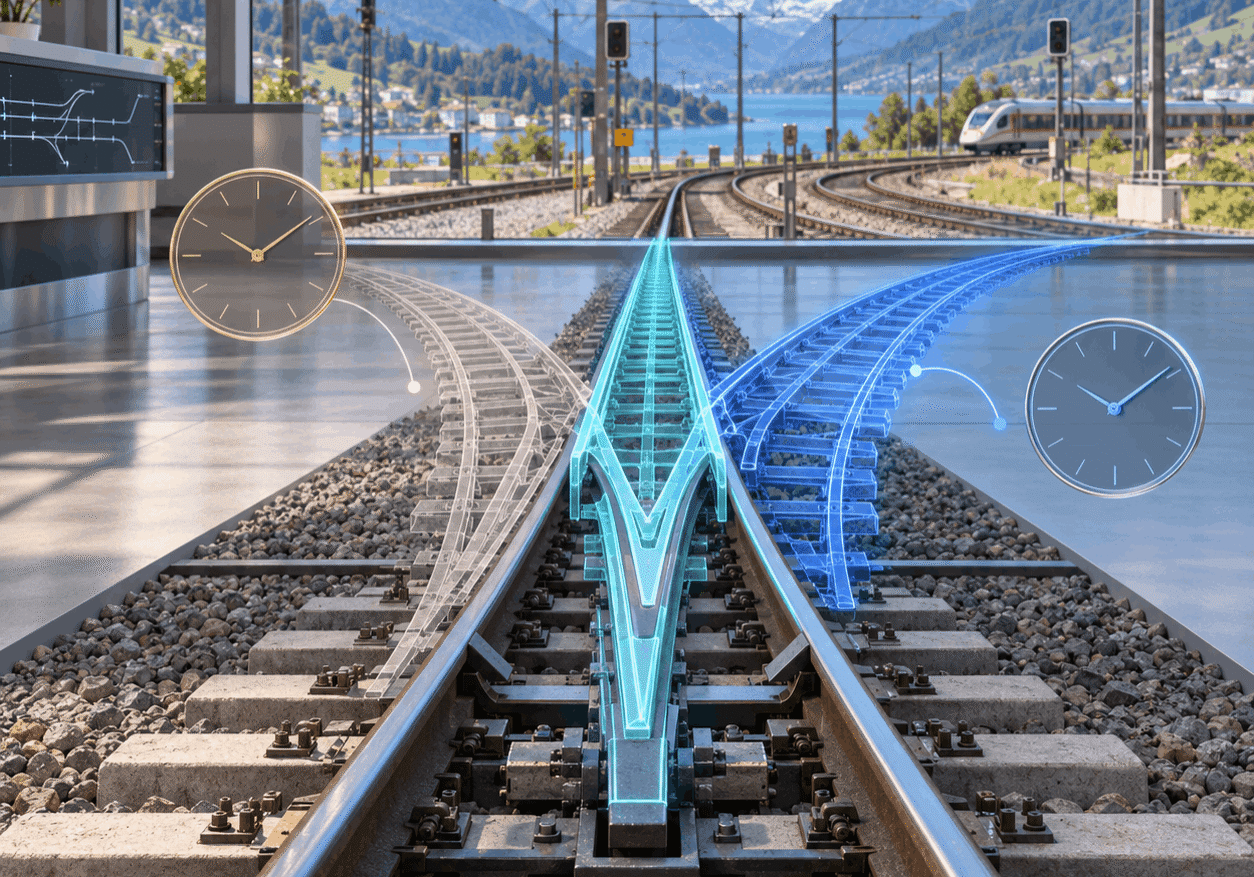
A useful twin must track not only where the railway is, but when.
Ahead of that departing train lies a railway network of tracks, tunnels, bridges, switches and signals. While one train accelerates toward Bern, another disappears beneath the Alps. Maintenance crews move into overnight work zones, signals change and engineers revise sections of railway that won’t exist for years to come.
Now imagine creating a digital twin of it all.
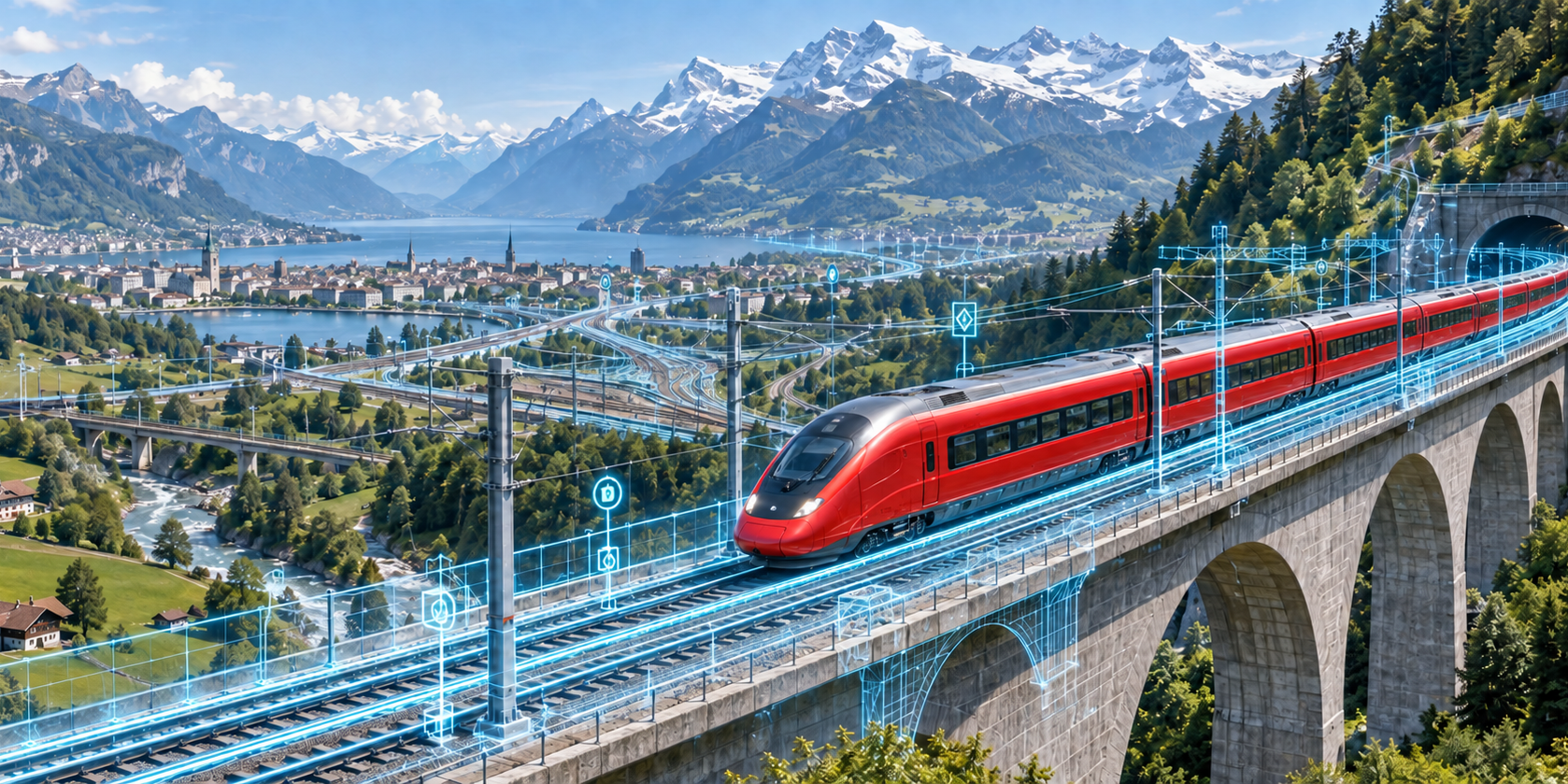
I’m not talking about a tidy model of one station or bridge. I’m talking about the entire Swiss rail network, alive and changing while trains sweep through tunnels, glide between cities and climb into the Alps.
It sounds ambitious. Then again, this is Switzerland. If anyone was going to look at a national railway and think, “We should organize every last switch,” it was probably going to be the Swiss.
Switzerland Is Building a Second Railway
Swiss Federal Railways, better known as SBB, is developing a digital twin of the country’s rail network. Its Integrated Topology Platform, or ITOP, is intended to represent railway infrastructure from tracks and switches to signals, along with the relationships among those assets.
That last part is where the twin gets tricky.
A map can show where a signal stands. A useful digital twin must understand which track it controls, which other equipment it interacts with and what could happen elsewhere if something changes.
Before ITOP, SBB’s infrastructure information was held in multiple systems and maintained for different purposes. Data that worked perfectly well for one department wasn’t necessarily current, complete or organized correctly for another.
More than ten specialist disciplines needed to agree on exactly what the railway contained and how its parts related to one another.
One team may identify an asset by location, another by function and a third by an internal number that looks as if it was assigned by an over-caffeinated Alpine marmot. Put those records into one database and you haven’t necessarily created order. You may simply have built a faster way for people to disagree.
One team may identify an asset by location, another by function and a third by an internal number that looks as if it was assigned by an over-caffeinated Alpine marmot.
A Digital Twin With Two Watches
Railways change. Tracks are realigned. Signals are replaced. Stations are expanded. Maintenance teams work through the night so passengers can arrive the next morning blissfully unaware of what happened while they slept.
Plans change too. A proposed layout may be entered on Monday, revised on Thursday and only approved months later. Another option may be studied, costed and rejected, but still remain important for understanding how the final decision was reached.
The digital twin that SBB is building therefore needs to keep track of two kinds of time. Its bitemporal data system records changes in an asset’s physical lifecycle, including construction, maintenance and replacement. It also records changes in the planning process and in SBB’s knowledge of that asset. In simple terms, the twin needs to know both when the railway changed and when SBB learned about or recorded that change.
Suppose an engineer needs to reconstruct why a maintenance decision was made six months ago. The latest information may show what is known today. It may not show what the team knew when it made the decision.
A conventional system tends to keep polishing the present until the past disappears beneath it.
A conventional system tends to keep polishing the present until the past disappears beneath it. SBB’s approach preserves the journey as well as the destination.
For CAD managers, that should sound familiar. Replacing an old drawing with the latest revision may leave everyone with a clean folder, but it can also remove the evidence behind earlier decisions. Sometimes yesterday’s “outdated” file is tomorrow’s answer to a very expensive question.
This Isn’t One Enormous 3D Model
It’s tempting to picture SBB’s digital twin as a glowing virtual Switzerland, perhaps with tiny trains gliding through the Alps and every departure rendered to the second.
The reality is less cinematic, but more useful.
The twin is better understood as connected infrastructure information. Geometry matters, but so do asset identities, functional relationships, operational requirements, maintenance records and planned changes.
SBB also uses BIM for construction projects. Planning teams define the models and data required of each discipline. Point-cloud capture has specified requirements. BIM execution plans establish how teams will collaborate, while model-checking procedures help verify data quality.
Project participants coordinate through a cloud-based Common Data Environment, or CDE. Internal specialists and outside contractors can use their own modeling tools, but required BIM deliverables are submitted through SBB’s project CDE.
On a network this large, insisting that every architect, civil engineer, signaling specialist and contractor use one application would be a bit like insisting that every passenger wear the same shoes.
Instead, SBB can standardize the information it needs, how that information should be structured and how it will be checked.
The software used to create a model matters, but whether participants can understand and use the data matters more.
The Awkward Gap Between Project and Asset
During a project, information revolves around the work being designed and built. Once construction ends, the organization must manage the assets left behind.
That handover can feel like watching passengers change trains with six suitcases and a 40-second connection. Everything is supposed to make it across. But confidence can get wobbly.
A BIM model may be excellent for coordinating a station renovation, identifying spatial conflicts or producing construction documentation. That doesn’t automatically make it suitable for planning maintenance 20 years later.
Useful information must reach the right operational systems, remain attached to the equipment it describes and stay current long after the contractors have left and the ribbon-cutting scissors have gone on display in an executive office somewhere.
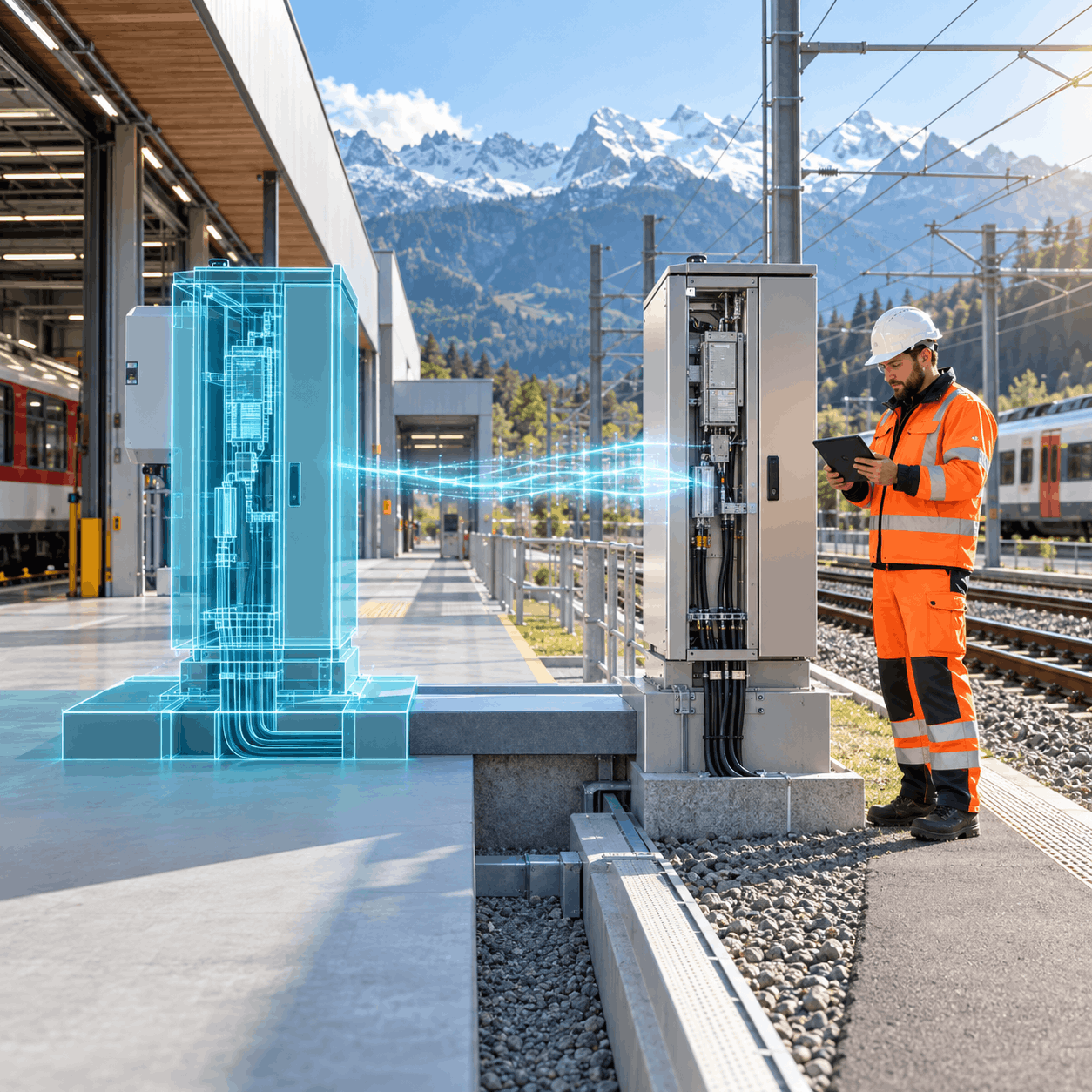
SBB says it’s developing an Asset Information Model Common Data Environment, or AIM-CDE. This will eventually connect its project CDE with the organization’s inventory and master systems. Current SBB documentation indicates that environment isn’t available yet.
That’s important. SBB has established its vision for digital twin technology, but the information infrastructure supporting it is still evolving.
This isn’t a finished virtual railway, politely waiting on a server. SBB is building it while the real railway races through tunnels, crosses viaducts and carries passengers who quite reasonably expect every signal, switch and timetable to function.
Project information has one more connection to make: the one into operations.
Meanwhile, the Real Trains Keep Moving
The network itself isn’t standing still while its digital counterpart takes shape. SBB is moving forward with a long-term program to modernize hundreds of railway interlockings, the safety systems that prevent conflicting train movements. The first new digital interlockings are expected to enter service in 2029.
In July 2026, SBB also announced preparations for a new digital rail-control system. It’s intended to connect with future digital interlockings and the timetable system, with phased introduction planned for the 2030s.
Every new system must exchange information with the physical infrastructure, operational technology and other digital systems around it. Each new connection also raises the cost of getting that information wrong.
A twin that’s “almost right” may be impressive during a demonstration. Railways, unfortunately, are rather particular about where the tracks actually are.
When a drawing is used only as a drawing, an incorrect revision or broken reference can delay a project. When the information contributes to maintenance planning, capacity calculations or railway operations, accuracy has a much bigger job to do.
A twin that’s “almost right” may be impressive during a demonstration. Railways, unfortunately, are rather particular about where the tracks actually are.
What CAD and BIM Teams Can Learn From SBB
Most organizations won’t attempt to model an entire national rail network. Scale it down, though, and SBB’s information challenge begins to look remarkably familiar.
Many organizations have drawings created in different applications and software versions. Reference files may have been moved, CAD standards may have changed and outside consultants may have followed their own conventions. One record shows what the engineers designed. Another shows what the contractor actually built. A maintenance report reveals the equipment was later replaced, but the original drawing was never updated.
An attractive interface can’t make those contradictions disappear.
Before creating a digital twin, an organization needs to ask some decidedly unglamorous questions.
Can every asset be identified consistently? Can CAD files and models be exchanged without losing information? Are revisions and references preserved? Can project data move into asset-management systems? Who checks it? Who updates it? Who notices when the virtual switch and the steel one beside the track no longer agree?
Dependable CAD files are part of the answer.
Standards may need to be applied across thousands of drawings, something Axiom’s Global File Changer is designed to automate for MicroStation users. RefManager can help identify and resolve reference-file problems when project files move or change, while FileFixer can detect and repair damaged design files. These are practical parts of a much larger challenge: keeping legacy information usable as software, people and projects change.
None of that is as visually exciting as watching a virtual train sweep through a digital Alpine valley. It is, however, what keeps the digital train on the digital tracks.
Switzerland is building a second rail network from data, one switch, signal and relationship at a time. It must move alongside the physical railway, absorbing each replacement, revision and newly approved plan without losing sight of what came before.
A digital twin can travel only as far as the information beneath it will carry it.
Its most valuable lesson isn’t about the size of the undertaking or even its enviable precision. It’s simply this: A digital twin can travel only as far as the information beneath it will carry it.

Axiom's President
Oscar Albornoz
Feel free to share this article on your social media:
