
CAD/BIM Tips & Tricks
Engineering the Edge: Florida’s Shift Toward Adaptive Resilience
2 March 2026
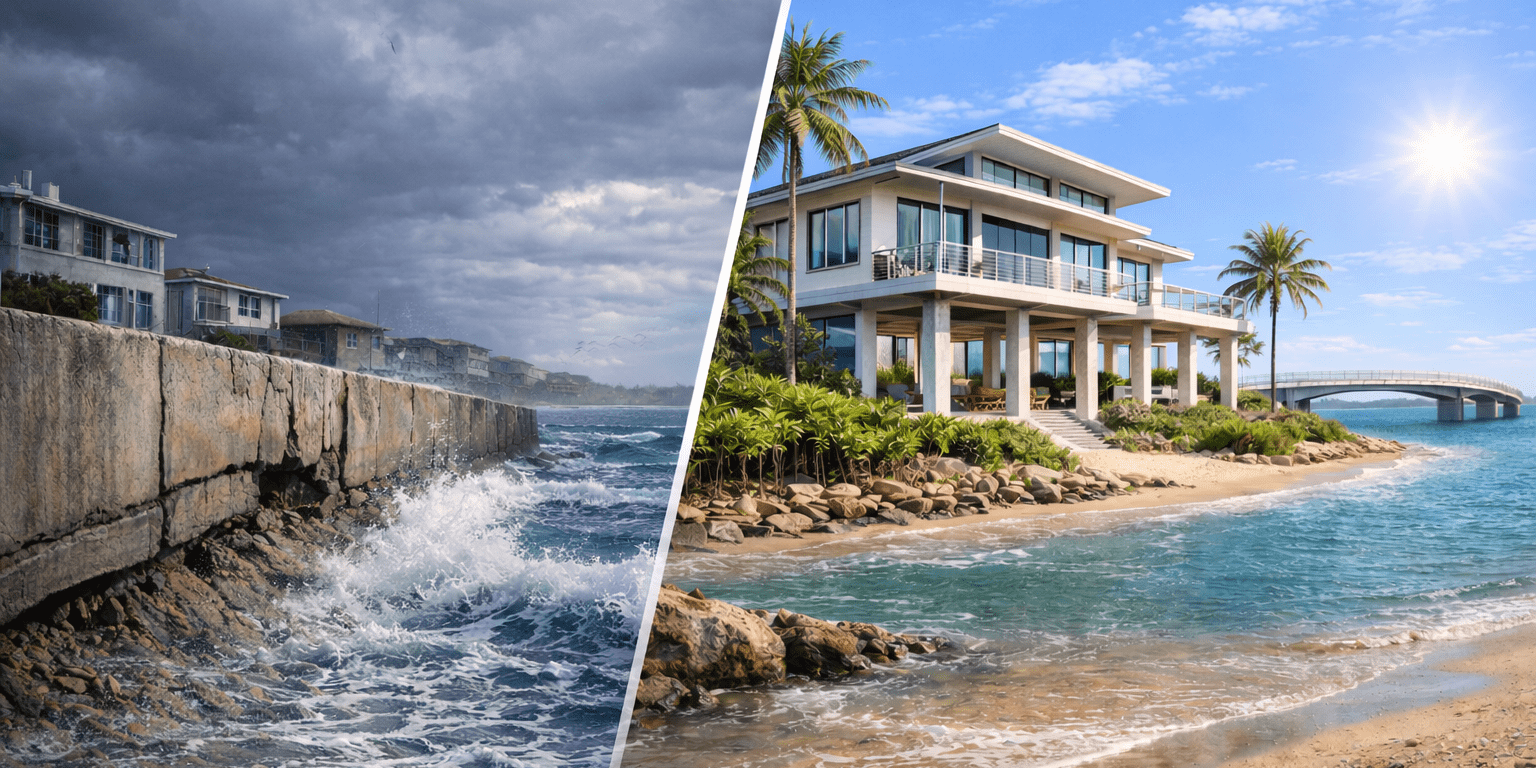
Let’s be honest: Building in Florida has always been a high-stakes game of “The Floor is Lava,” except the lava is sand and corrosive salt water and, according to the National Oceanic and Atmospheric Administration and the US Geological Survey, it’s rising. For decades, Florida’s collective engineering answer to the Atlantic and the Gulf was essentially a very expensive “Keep Out” sign in the form of vertical concrete seawalls.
There’s a much-needed shift from traditional engineering practices toward something known as adaptive resilience.
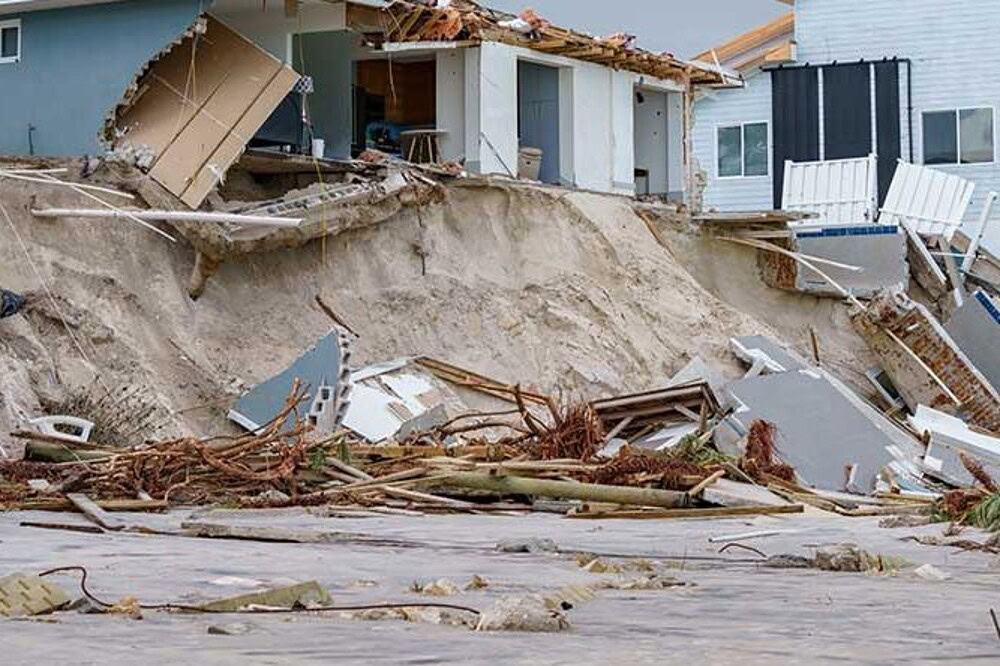
But as any civil engineer who has spent twenty minutes in a Category 4 surge knows, the ocean doesn’t care about our signs (or walls).
In the AEC, DoT and MEP industries in Florida and other coastal states, there’s a much-needed shift from traditional engineering practices toward something known as adaptive resilience. It’s the difference between trying to punch a wave and learning how to surf it. For those responsible for Florida’s infrastructure, this means that structural design, material science and MEP layouts have to get a whole lot smarter.
The Resilient Florida Act
Behind this shift towards adaptive resilience lies a landmark piece of legislation, Senate Bill 1954, also known as the Resilient Florida Act. Signed into law in 2021, this bill transformed coastal resilience from a “best practice” scenario into a legal and financial requirement that impacts architects, engineers and developers.
The Three Pillars of SB 1954
The bill established a coordinated, statewide approach to flooding by creating three major initiatives:
- The Resilient Florida Grant Program. Managed by the Department of Environmental Protection (DEP), this program provides millions of dollars in grants to local governments. These funds are used for vulnerability assessments (finding the weak spots) and adaptation projects (building the solutions, like the upgraded open-plinths and dry-boxes we discuss below).
- The Statewide Flood Vulnerability & Sea Level Rise Data Set. This created a unified “source of truth.” Previously, every city had its own data. Now, the state requires the use of NOAA Intermediate-Low and Intermediate-High projections to ensure all new infrastructure is built for the same future.
- The Florida Flood Hub. Located at the University of South Florida (USF) in St. Petersburg, this research center coordinates data and innovation to help the state stay ahead of the “splash zone.”
Why It’s a Game Changer for the AEC Industry
Before SB 1954, many resilience efforts were voluntary. Now:
Adaptive resilience ensures that infrastructure remains functional and durable by working with natural forces rather than simply fighting against them.
- Funding is Tied to Data. You cannot get state money for a project unless you can prove it meets the bill’s strict flood-modeling standards.
- Critical Assets are Protected. The bill provides a legal definition for “critical assets,” including transport, utilities and emergency services, requiring them to be hardened against the “100-year flood” event.
- Regional Cooperation: It encourages cities to form “Resilience Coalitions,” recognizing that water doesn't stop at city limits. If, for example, one city floods, it can affect neighboring cities too.
So, what exactly is adaptive resilience?
Adaptive Resilience 101
Adaptive resilience represents a new perspective in coastal engineering, moving away from the rigid “fortress” mentality of the 20th century toward a philosophy of flexibility and strategic coexistence with the environment. (Surfing, not punching, remember?)
Rather than attempting to resist the ocean’s force through static barriers like vertical seawalls, adaptive resilience focuses on “riding” the surge through smart structural articulation and advanced material science.
This approach integrates features such as:
- New and improved open-plinth designs that allow water to flow beneath a building.
- Non-corrosive reinforcement inside concrete to ensure longevity in saltwater.
- Elevated MEP (Mechanical, Electric, Plumbing) stacks that keep critical systems operational during flood events.
We’ll discuss each of these points below.
By acknowledging the phenomenon of rising tides, adaptive resilience ensures that infrastructure remains functional and durable by working with natural forces rather than simply fighting against them.
1. The Physics of the Splash
Before we talk about the “how,” we have to respect the “why.” In coastal engineering, we deal with two distinct issues: Hydrostatic and hydrodynamic loads.
If you haven’t designed and built your structure to handle that, your building potentially becomes an accidental (and very leaky) submarine.
The Heavyweight: Hydrostatic Pressure
Hydrostatic pressure is the quiet killer. It’s the weight of the water pressing against your foundation walls. As every professional engineer knows, the pressure (P) increases linearly with depth (h):
P = ρgh, where:
- ρ (density of salt water) is 1,025kg/m3
- g (gravity) is 9.8 meters/second2
- h (height of the water column)
In a three-meter (ten-foot) surge, that’s the equivalent of 3,125 kilograms per square meter (640 pounds per square foot) of lateral pressure pushing inward on your foundation. If you haven’t designed and built your structure to handle that, your building potentially becomes an accidental (and very leaky) submarine.
The Battering Ram: Hydrodynamic Loads
Then there’s the hydrodynamic load — the kinetic energy of moving water. When a wave hits a flat surface, the force can be ten times higher than static pressure. This is why we’re seeing a mandated move toward increased use of open-plinth design. By using piles (with newly engineered salt-resistant reinforcement) to elevate the structure above the base flood elevation (BFE), we create a situation where, instead of the energy hitting the building, it passes underneath it.
Open-plinth design is a classic example of reducing the surface area of failure and is FEMA-approved. Sure, as a design concept, open-plinth has been around for a while, but changing technology and legal requirements are resulting in changes both in terms of the need for and the structure of modern open-plinth design.
Where older plinth homes sat on either wooden or steel-rebar concrete stilts, for the next generation of plinth homes, think rust-resistant rebar and plinth heights as dictated by the National Oceanic and Atmospheric Administration’s recommendations.
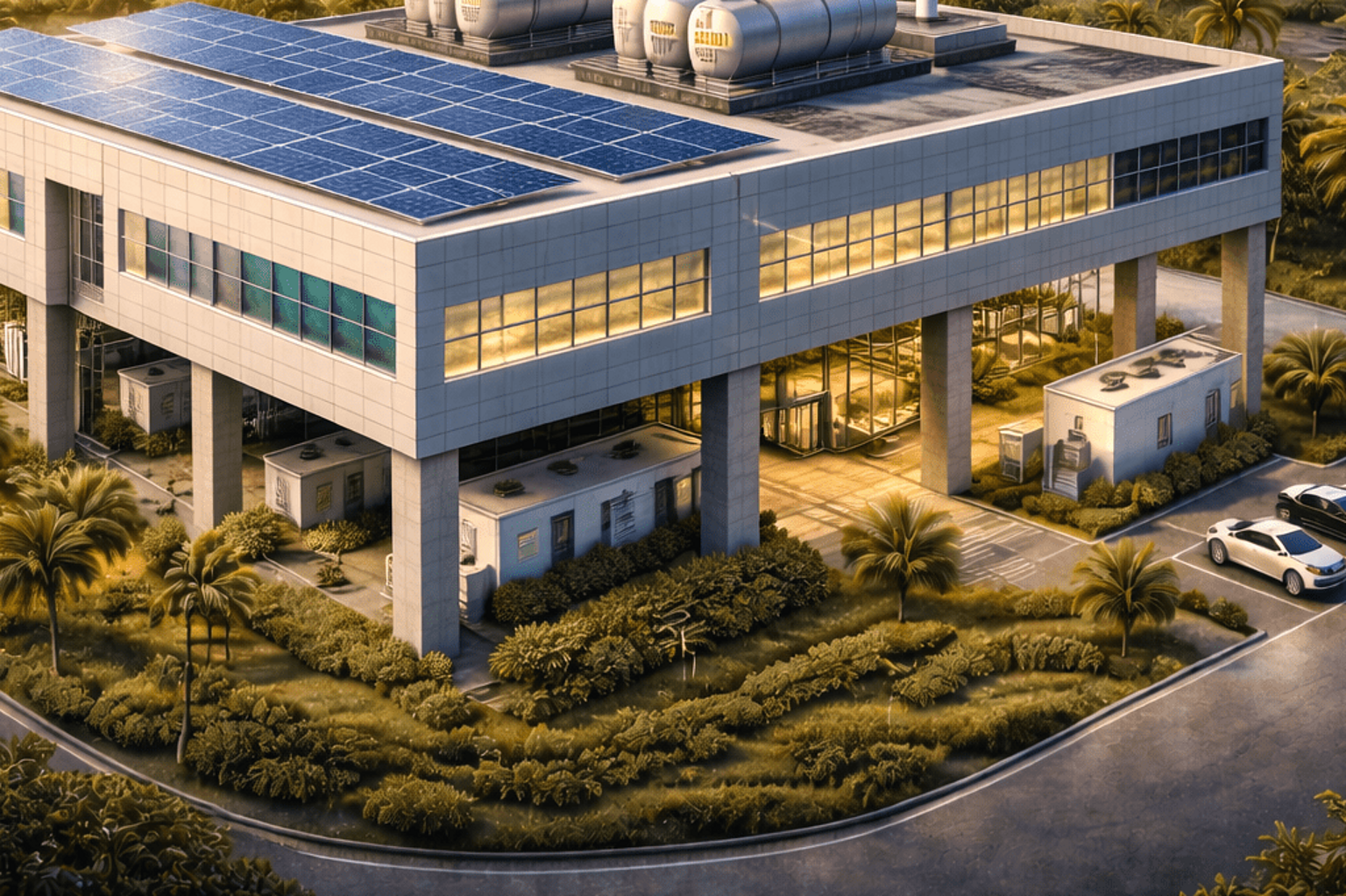
With adequate "island mode" power supply elevated above the flood zone, a resilient building could function independently for up to 96 hours in the event of a major power outage.
2. The Reinforcement Revolution: Because Steel is a Ticking Time Bomb
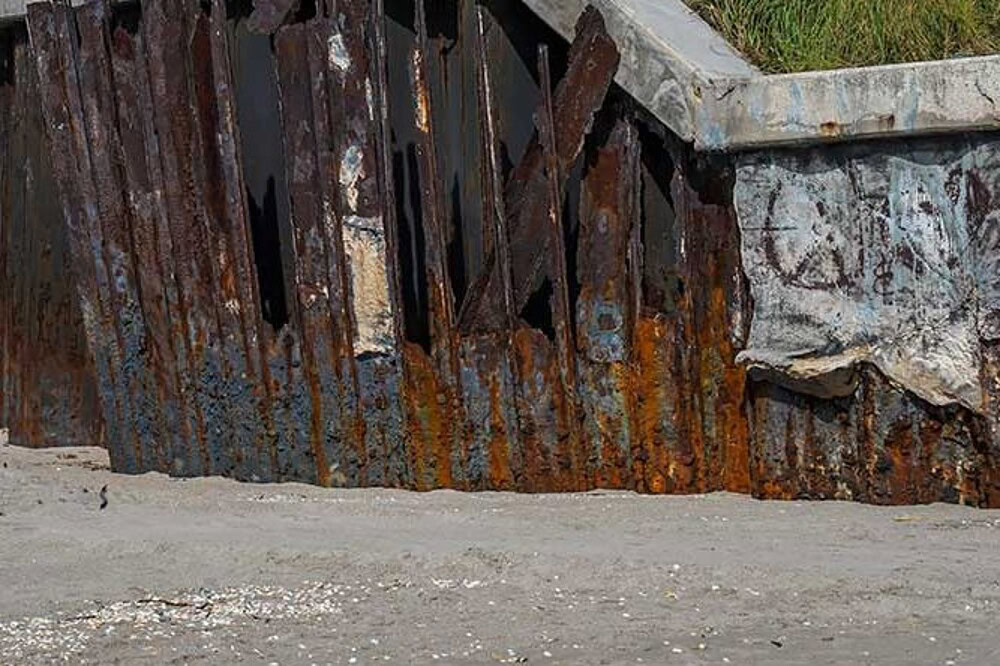
If you want to start a fight at an American Society of Civil Engineers social event, ask about the service life of black steel rebar in a coastal zone. We’re all familiar with the “spall of death”: saltwater infiltrates concrete, hits the steel, the steel oxidizes and expands, and the concrete cover pops off like a champagne cork — only without the accompanying merriment.
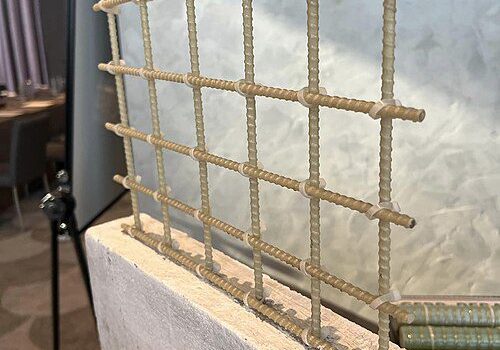
GFRP (Glass Fiber Reinforced Polymer) lasts longer than steel rebar and weighs less.
Enter GFRP (Glass Fiber Reinforced Polymer) for the win.
Back in the late 1980s and early 1990s, glass fiber reinforced polymer had limited application and was still undergoing research. Then came ACI 440.11-22, the first comprehensive standard covering the use of nonmetallic, GFRP reinforcing bars in structural concrete applications. By 2024, it had been adopted into the International Building Code. As a result, GFRP is finally getting the recognition it deserves.
- Zero Corrosion: GFRP is non-metallic. It simply doesn’t rust. This allows engineers to reduce concrete cover requirements (often by an inch or more) without sacrificing longevity.
- High Tensile Strength: GFRP Grade 100 offers a tensile strength of 100+ ksi (kips per square inch, which is equivalent to 1,000 pounds per square inch), nearly double that of Grade 60 steel.
- The Weight Factor: It weighs about a quarter as much as steel. For DoT bridge deck projects, this means faster installation and lower shipping costs.
- The Catch: Because it’s a thermoset material (meaning that once cured and hardened, it cannot be melted or reshaped), you cannot bend it in the field. Every stirrup and corner bar must be meticulously pre-bent at the factory. This puts a premium on BIM coordination. If your MEP guy realizes he needs a sleeve through a beam and the cage is already tied, you aren’t just “bending it out of the way.”
Overall, you can see how GFRP’s application in coastal areas could be highly beneficial.
3. MEP’s “Dry-Box” Strategy: Relocating the Brains
For MEP engineers, coastal resilience is essentially a game of “keep the electric stuff dry.” In the old days, we standardly tucked the electric meter and panel somewhere easily accessible at ground level. However, with flooding common during Florida’s hurricane season, in many cases, ground level is simply not the best location and modern electric meters and panels are being elevated.
The vertical MEP stack is the new standard.
- Elevated Switchgear: In coastal new builds and remodels, the primary electrical distribution is moving to the second floor or higher.
- Island Mode: For the MEP industry, “resilience” now means designing for 72 to 96 hours of “island mode” operation. In other words, enabling a facility’s power system to disconnect from the main utility grid and operate independently using its own local generation sources. This requires rooftop fuel storage or wind-rated solar-plus-storage.
- Submersible Conduits: For fire pumps or systems that must remain below the base flood elevation, there’s a shift toward marine-grade, encapsulated systems.
Internal sensors allow researchers to monitor the structural performance of its non-corrosive components in real-time.
4. DoT and the “Sacrificial” Roadway
The DoT has faced a unique challenge: Horizontal infrastructure (like roads) can’t climb to the second floor. The focus here is on permeable articulation. Instead of building roads that act as dams, engineers are designing “flow-through” structures.
- Oversized Culverts: Drainage is being designed for 100-year storm events (because you only “don’t need it” until you do).
- Articulated Concrete Blocks (ACBs): Using interlocking blocks for embankments that allow the road to stay intact even if it’s temporarily overtopped.
5. The Resilient Florida Boost
The Resilient Florida Program has funneled billions into vulnerability assessments. For AEC firms, this has turned resilience planning into a mandatory requirement for public funding. If you aren’t using the National Oceanic and Atmospheric Administration’s (NOAA) Intermediate-High Sea Level Rise (SLR) Projections in your site designs, you’re designing for a world that might not exist in 30 years.
Examples of Adaptive Resilience Projects in Florida
- Halls River Bridge (Homosassa): This was a flagship project for the Florida Department of Transportation. Completed in 2020, it was one of the first bridges in the state to be built almost entirely without steel rebar, using GFRP instead. This allows the bridge to withstand the coastal environment without the risk of internal corrosion or concrete spalling.
Even though construction is complete, the bridge remains a living laboratory for coastal engineering.
-
- Testing Longevity: It features 400 feet of removable test beams in the splash zone (areas in contact with waves, tides or spray). Engineers periodically remove these to perform destructive testing, verifying how well different types of fiber-reinforced polymers (FRP) withstand saltwater over time.
- Embedded Sensors: The bridge is equipped with internal sensors that allow researchers from the University of Miami, Florida A&M University and Florida State University College of Engineering to monitor the structural performance of its non-corrosive components in real-time.
- Service Life: While a standard steel-reinforced bridge is typically designed to last 75 years, engineers expect the Halls River Bridge to last at least 125 years due to its rust-proof design.
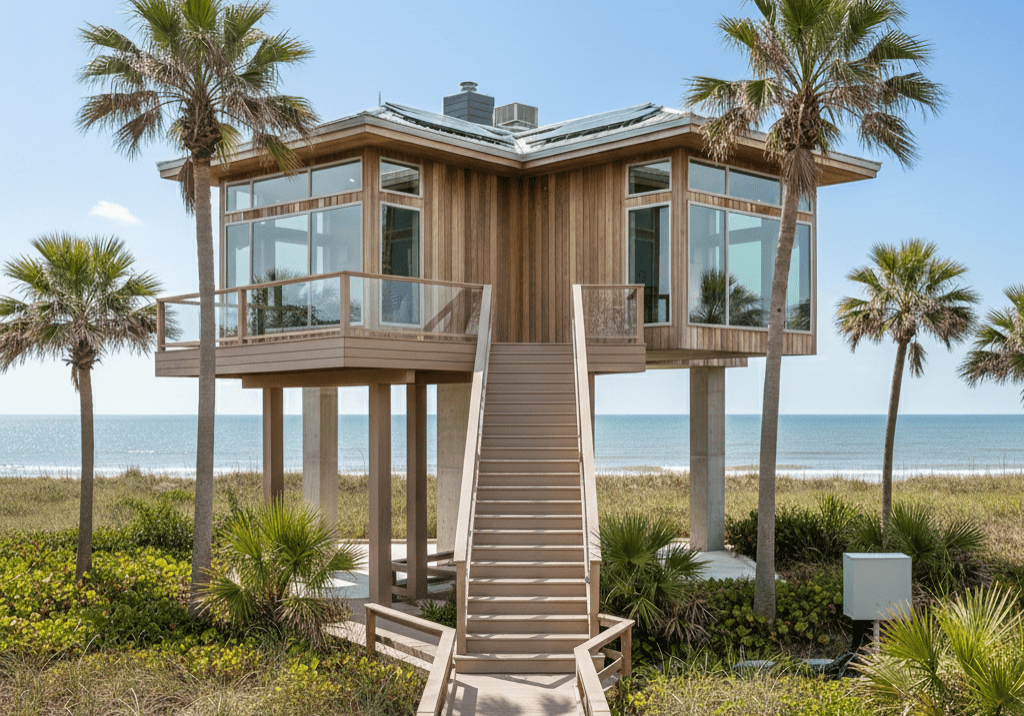
- Pedestal Homes: Due to updated Florida building codes and stricter floodplain requirements, pedestal homes are increasingly being built in coastal Florida. Their multi-sided elevated design allows both wind and water to flow around and under the structure, significantly reducing the pressure loads mentioned above.
While the earlier pedestal forms trace back to the hippy-inspired mushroom-shaped architecture of the 1960s and 1970s, the modern iteration is a high-performance machine utilizing rust-proof GFRP reinforcement, electrical “islanding” and hydrodynamic breakaway walls to survive conditions that would have demolished its mid-century predecessors.
In terms of pedestal height, architects and engineers aren’t merely designing to maximize the view or accommodate steeply sloped terrain. They’re building for the NOAA sea level projections 50 years into the future, not for past water levels that were typical 50 years ago.
- SR 23 (First Coast Expressway): This is a massive $296 million project in St. Johns County that includes “flow-through” designs and oversized water and sewer infrastructure to handle the increased rainfall and surge loads on State Route 23.
- Fort Myers Beach Water Reclamation Facility: Currently undergoing a $208 million restoration (scheduled for completion in December 2027), this facility is being redesigned with a flood-resilient footprint. This includes upgrading the electrical distribution systems and capacity to ensure it remains operational during surge events — a direct application of the above “relocating the brains” strategy.
- Statewide Resilience Plan: Florida recently approved a massive list of projects funded by the Resilient Florida Program. This includes $20 million for the C-7 Basin Resiliency in South Florida, $10 million for the relocation and hardening of a fire station in Daytona Beach (to ensure emergency services remain active during a flood), and many other projects.
Conclusion
Building for resilience in Florida isn’t just about thicker walls. It’s about a greater understanding of how our structures are built to “breathe” and coexist with the environment. Whether it’s swapping steel for GFRP or moving the MEP to the penthouse, the AEC industry is proving that we can outsmart and survive the splash.
