
Playtex and the Space Suit?
CAD/BIM Tips & Tricks
Who Made Neil Armstrong’s
Space Suit?
9 November 2023
Updated 5 April 2024
Share on Facebook Share on Twitter Share on LinkedinWhat were early astronaut suits made of and who made them? Would you be surprised to learn that it was a bra manufacturer that made the space suits worn by the crew of Apollo 11 for their historic Moon landing? As far as some of the materials are concerned, you may be somewhat amused on that score too. Come along for this voyage of discovery!
When Neil Armstrong took the first human step on the Moon and gave his famous one-sentence speech on July 20, 1969, “That’s one small step for man, one giant leap for mankind,” he was being supported by a brand-new technology that had to solve several problems: being both wearable and maneuverable, but also providing adequate protection against an alien environment.
Out of This World Fashion
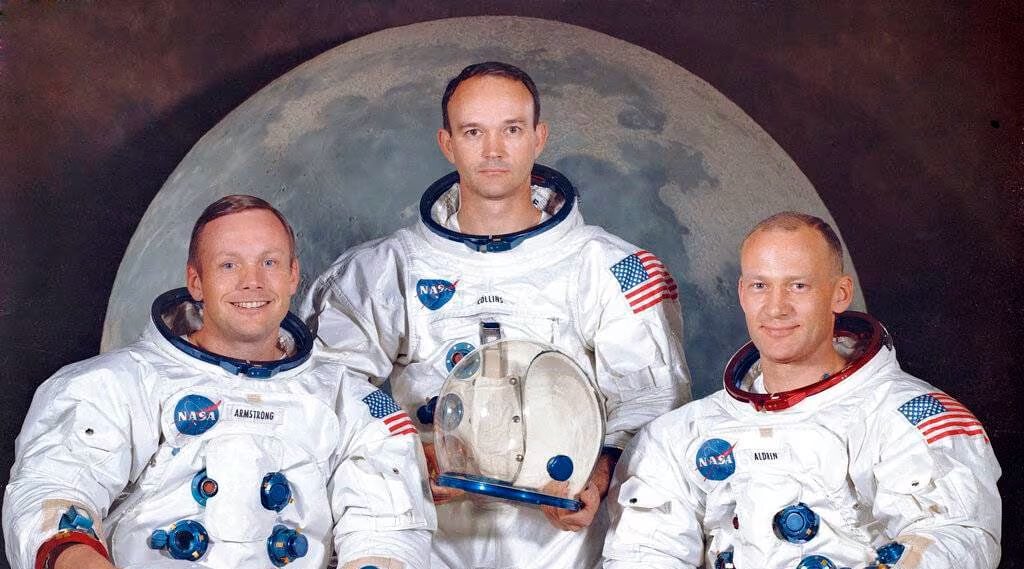
What were the requirements for the spacesuits worn by Neil Armstrong, Buzz Aldrin and Michael Collins?
- The suits had to be capable of being inflated and pressurized from the inside to replicate the atmospheric pressure required to sustain human life.

It would have been easy to build some kind of tank-like suit that could protect its human contents from the rigors of life in space. However, creating a suit that offered that level of protection combined with ease of motion turned out to be excruciatingly difficult.
Beating the Big Boys at Their Own Game
Three major defense contractors who had all previously worked with NASA were the primary candidates for the manufacture of the new space suits for the crew of the first lunar landing and anticipated Moonwalk.
Hamilton Standard had made the life-support backpacks the Apollo astronauts wore during their Moonwalks. B.F. Goodrich had previously made the Mark IV spacesuits worn by the Mercury astronauts. Litton Industries’ Mark I suit predated Sputnik and the space race.
The shortcomings of the competitors’ suits became obvious – one suit’s helmet blew off, while another had such wide shoulders that the astronaut couldn’t re-enter the mockup lunar module.
Playtex, renowned for its bras and girdles in the 1950s and 1960s, came out of left field. A division of the International Latex Company (ILC), Playtex was not a conventional choice.
The selection of Playtex – a company associated with female undergarments – as a potential candidate by NASA, a predominantly male-driven engineering entity, is a tale perhaps ripe for movie adaptation. Initially subcontracted to Hamilton Standard, Playtex was later fired in 1965 when Hamilton Standard decided to pursue the suit contract independently.
The Playtex design withstood rigorous testing alongside its competitors. The shortcomings of the other suits became obvious during the trials – one suit’s helmet blew off, while another had such wide shoulders that the astronaut couldn’t re-enter the mockup lunar module after inflation. Talk about a deadly fashion faux pas. Internal NASA documents indicated significant mobility limitations in the competing suits, making routine tasks impossibly challenging.
In a compromised suit, an astronaut could lose consciousness in ten to fifteen seconds and die within a minute.
The handstitched Playtex suit victoriously emerged as the superior choice, the clear winner. It demonstrated exceptional performance and versatility, which is not surprising – considering that for decades, Playtex specialized in garments that offered excellent support without restricting the wearer’s range of motion.
A Woman’s Touch: Caring Contribution to Space Safety
With the contract in hand, additional seamstresses were recruited from Playtex and a strong sense of teamwork grew between them and the engineers throughout the project.
Actively encouraged to share their expertise and insights, the women taught the engineers sewing techniques and proposed improvements to the suits during the collaborative process. The seamstresses’ contributions were fundamental in ensuring the successful functionality of the suits, a sentiment notably supported by Leonard (Lenny) Shepherd, the head of the suit development project.
Deeply committed to the project, Ellie put in extensive hours at work and rarely left the plant, sometimes for only brief two-hour intervals.
The seamstresses from Playtex were acutely aware of the fact that the lives of the astronauts potentially depended on the quality of their detailed handiwork. Eleanor “Ellie” Foraker shouldered a massive responsibility and transitioned from sewing waterproof latex pants for babies to being the space suit assembly advisor.
The seamstresses helped Armstrong, Aldrin and Collins bring us all just a little closer to the heavens – before bringing them safely home.
Suits were regularly x-rayed to ensure that no stray pins that could potentially puncture the suit, were left in the fabric. In a compromised suit, an astronaut could lose consciousness in ten to fifteen seconds and die within a minute.
Obviously, no such disaster occurred during the Apollo 11 mission, and Armstrong later said of the suit, “Its true beauty was that it worked. It was tough, reliable, almost cuddly.”
 The Apollo 11 pressure garment without the outer layer and visor assembly.
In the final phases of suit production, Shepherd demonstrated his respect and commitment by staying at the manufacturing plant alongside Ellie Foraker during many late nights. He assisted her in maneuvering the bulky suits as she sewed them using one of the two modified Singer sewing machines, affectionately named Big Moe and Sweet Sue.
ILC Project Manager, Homer Reihm, describes the sound of the plant. “Our sewing shop didn’t go rrrrrrrrrrrrr like commercial sewing shops. It went ka-lup, ka-lup, ka-lup – because we were interested in accuracy.” One methodical stitch at a time.
Deeply committed to the project, Ellie put in extensive hours at work and rarely left the plant, sometimes for only brief two-hour intervals. She worked tirelessly without breaks or vacations for three years, a demanding schedule that eventually led to two nervous breakdowns. Nonetheless, the dedication of Ellie Foraker and her small team of loyal women ensured the safety of the suits – helping Armstrong, Aldrin and Collins bring us all just a little closer to the heavens, before bringing them safely home.
High-Tech Progress
To create the astronaut’s gloves, for example, CAD allows the designers to program the characteristics of the material that is being used. Based on a laser scan of the astronaut’s hand, a 3D-printing process called stereolithography is used to print the glove from resin, which is then dipped in a flexible polymer. The whole suit undergoes rigorous testing that simulates all the possible extremes that an astronaut may face.
“Its true beauty was that it worked. It was tough, reliable, almost cuddly.” – Neil Armstrong
You may not be contemplating sending anyone into space, but we know that precision is equally important for your projects, and we have solutions that take care of the details, whether you’re working in MicroStation, Revit or AutoCAD. Call a Service Consultant at 727-442-7774 to get any questions answered or chat with us online at AxiomInt.com today.
Axiom. CAD and BIM made easier.
