
CAD/BIM Tips & Tricks
What Most Teams Miss in the Shift From 2D to 3D
Who’s Losing 2D First — and Why It Should Matter to You
11 May 2026
2D drawings are not just a legacy artifact in a BIM workflow. They aren’t “just documentation.” They’re still the agreement that defines responsibility, liability and final intent. And that gap, that disconnection between perception and reality, is where costly mistakes, rework and confusion can still happen.
For CAD and BIM managers, the shift from 2D to 3D isn’t just theoretical. It directly affects how projects are coordinated, what gets delivered and, critically, what carries legal and contractual weight. On many projects today, the model may drive the work, but the drawing still defines responsibility.
The tools may be 3D, the models may be detailed and the workflows may look “BIM-driven.” Yet when it comes to contract time, 2D drawings still overwhelmingly hold the position of the official, legally binding contract document. Yes, the Model as Legal Document (MALD) is seeing increased adoption, but it’s far from universal at this point.
For decades, the AEC industry has relied on 2D drawings as the universal language of design and construction. Plans, sections and elevations. If it couldn’t be printed, stamped and rolled into a tube, it wasn’t real. There was a certain comfort in that. A kind of order. A drawing set was tangible, finite and authoritative.
But walk onto a large jobsite today and you’ll see continually accumulating evidence of the change we all know very well: fewer plan rolls, more tablets. Fewer redlines, more real-time coordination. Fabrication teams are pulling geometry straight from BIM models instead of reading it from paper.
So, are 2D drawings on their way to total demise? And why should it matter to you?
So, are 2D drawings on their way to total demise? Or are they simply losing their status as the center of the design universe? And why should it matter to you?
Let’s take a look at what’s actually happening inside today’s most advanced skyscraper projects, and what it means for architects, engineers, DOT teams and designers working in CAD or BIM.
From Drawings to Data: The Real Shift
BIM isn’t just “3D drawings with extra steps.” Not even close.
Let’s review something you likely already know but nonetheless bears mentioning here: BIM represents a fundamental shift from describing buildings to defining them. Instead of drawings being the source of truth, BIM introduces a data-rich model that drives:
- Geometry.
- Quantities.
- Coordination.
- Scheduling.
- Cost.
- Fabrication.
- Operations.
Trying to resolve that twisting façade in 2D would have been like trying to solve a Rubik’s Cube while wearing oven mitts.
2D drawings obviously still exist, but increasingly, they’re outputs of the model, not the place where design decisions originate. That distinction matters more than it sounds, because once the model becomes the legal document, everything downstream changes:
- Clash detection replaces manual overlay coordination.
- Schedules update automatically instead of being rebuilt.
- Changes occur across multiple disciplines instantly.
- Fabrication can pull directly from geometry without reinterpretation.
And somewhere along the way, the act of drafting sheets can start feeling less like design and more like documentation duty. Yet, for now, the 2D drawing persists.
Skyscrapers That Couldn’t Exist Without BIM
It’s easy to talk about this shift in abstract terms, but the reality is already built, quite literally, in steel and glass.
Shanghai Tower (China)

At 632 meters (2,073 feet), the Shanghai Tower isn’t just tall. Its gleaming, silvery, spiraling facade is more than an exercise in visually striking geometry. It’s also computationally demanding in terms of reducing wind loads and improving performance. This required:
- Full multidisciplinary BIM coordination.
- Integrated structural, façade and MEP modeling.
- Model-based decision-making during design and construction.
- Extension into facility management after completion.
Trying to resolve that twisting façade in 2D would have been like trying to solve a Rubik’s Cube while wearing oven mitts.
One Za’abeel (Dubai)
If Shanghai Tower is elegant complexity, One Za’abeel is structural audacity. Its defining feature, The Link, is the world’s longest occupied cantilever. And it’s not something you casually sketch and “hope for the best.” This project relied on:
- High-fidelity digital models for structural analysis.
- Precision fabrication driven directly from BIM data.
- 4D (3D plus time or scheduling) sequencing to coordinate the installation of massive structural elements.
At this level, 2D drawings don’t necessarily completely disappear, but they stop being the thing you rely on to understand the building.
HEKLA Tower (Paris)
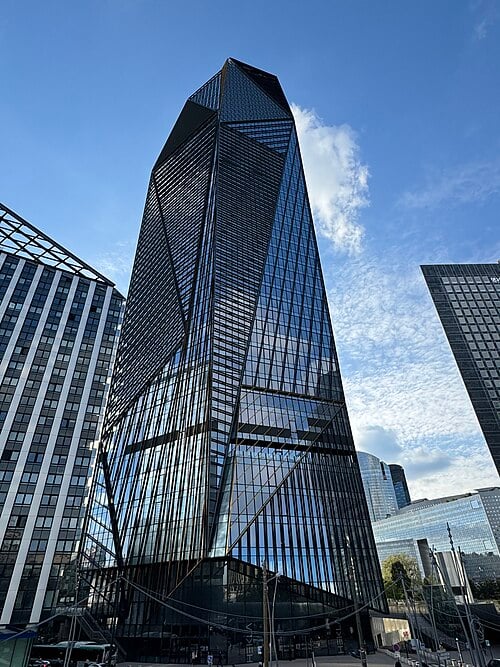
Designed by Jean Nouvel, the gemstone-faceted HEKLA Tower represents another shift: collaboration at scale.
- Multiple firms worked simultaneously in shared models.
- Cloud-based BIM environments replaced file exchanges.
- Real-time coordination was required, instead of drawing-based back-and-forth.
The old workflow was: “Send drawings, wait, revise, repeat.” The new workflow is: “Open the model. The data’s already there.”
If you’ve ever had a project with five different element weights all trying to represent the same dashed line, you know the pain of Standards Drift. It’s like a violation of the Geneva Conventions of CAD.
Who’s Losing 2D First? (And Who Isn’t)
Not all sectors are transitioning to 3D at the same speed — and that’s where things could get interesting.
The old workflow was: “Send drawings, wait, revise, repeat.” The new workflow is: “Open the model. The data’s already there.”
Fabrication & MEP: Already There
If you want to see the future of drawing-less workflows, look at fabrication.
- Prefabricated MEP (Mechanical, Electrical, Plumbing) systems rely on exact geometry.
- Spool drawings are often auto-generated from models.
- CNC (Computer Numerical Control) machines read model data directly.
There’s very little room for interpretation here. A millimeter off isn’t merely a redline. It’s a potentially expensive problem.
The reality is that in many fabrication workflows, 2D drawings are already just a formality.
Structural Engineering: Close Behind
Structural teams are increasingly model-driven, especially on complex projects, including:
- Parametric systems and non-standard geometries.
- Tight integration with analysis tools.
- Direct links between design and fabrication.
The more unconventional the structure, the less useful traditional drawings potentially become.
Large Commercial & High-Rise Construction: Rapidly Shifting
This is where BIM really flexes its value, with:
- Massive coordination across disciplines.
- Global teams working across time zones.
- Tight schedules that don’t tolerate rework.
Drawings may still be issued, but decisions are increasingly made based on the 3D model, long before the drawings exist.
Infrastructure and Transportation (Hello DOTs): In Transition
Infrastructure is a fascinating fifty-fifty middle ground.
- It’s still heavily drawing-based due to standards and approvals.
- There are strong legacy workflows for good reason: They’re legally clear, universally understood and still incredibly reliable in the field.
- There is, however, increasing adoption of model-based delivery, especially in MicroStation ecosystems.
With digital delivery mandates emerging globally, this sector may shift faster than expected.
Residential & Small Projects: Holding On to 2D Drawings
At the smaller scale, there’s:
- Simpler geometry.
- Lower tech investment.
- Faster turnaround expectations.
Here, drawings still make a lot of sense. And they probably will for a while.
Your model isn’t just documentation anymore. It’s production infrastructure.
So … Why Are We Still Making Drawings?
If BIM is so capable, why hasn’t 2D disappeared altogether? The answer lies in the fact that the industry isn’t only technical. It’s also contractual, cultural, and, perhaps most importantly, human-centered, both in terms of design, construction and purpose.
1. Most Contracts Still Speak “Drawing”
Many AEC agreements define deliverables in terms of:
- Issued sheets.
- Stamps and signatures.
- Revision histories.
Until contracts evolve and the 3D model is universally accepted as the legal document, drawings often remain the official record, even if everyone secretly trusts the model more.
2. Humans Like Simplicity
Let’s not overcomplicate things. Sometimes all you want is:
- A clean drawing.
- A quick detail.
- A view you can see at a glance without negotiating the orbit of a model.
Drawings are efficient, familiar and fast. And on many busy job sites, that still matters.
3. The Supply Chain Isn’t Fully Digital
Even on advanced projects:
- Some trades still rely primarily on 2D drawings.
- Interoperability between platforms and tools isn’t always perfect.
- Not everyone has the same grasp of and proficiency in BIM.
In other words, the weakest link often pulls the workflow back to 2D.

4. Trust Is Still Catching Up
There’s an unspoken question on many projects: “Can we completely trust that the model is right?” Until the answer is consistently “yes,” and provably so, drawings will continue to act as a sort of predictable safety net.
The Projected “Retirement” of 2D
2D Drawings aren’t being eliminated, but they are being repositioned. In practical terms, you’ll most likely:
- Design in BIM.
- Coordinate in BIM.
- Build from BIM.
And then … you’ll generate drawings as needed. Ultimately, with universal adoption of the model as legal document, drawings will become an optional “report,” not an integral part of the process.
The Emerging Endgame: The Model as Contract
One day, BIM will, no doubt, reign supreme, from inception to built reality. When the 3D model becomes the legally binding contract, that’s when everything changes:
- Quantity takeoffs come directly from BIM.
- Construction sequencing is embedded.
- Fabrication reads model geometry directly.
- Digital twins extend into operations.
At that point, drawings aren’t just secondary. They’re optional. Or obsolete. We haven’t reached that point yet, but we may be getting closer than people realize — although people have debated this for decades, so you be the judge.
What This Means for Designers (You)
If you’re working in Revit®, MicroStation®, AutoCAD® or BricsCAD®, this shift likely isn’t purely theoretical at this point. It’s probably already impacting your day-to-day work.
If you’re thinking in sheets, you’re designing outputs. If you’re thinking in models, you’re designing systems. And that shift changes everything:

- Model accuracy matters more than drawing aesthetics.
- Data structure matters as much as geometry.
- Coordination becomes continuous, not milestone-based.
And perhaps most importantly, the model isn’t just documentation anymore. It’s production infrastructure.
Patience is a Virtue
Will 2D drawings disappear completely? Not tomorrow. Possibly not even this decade. Because on every project, you’ll still find:
- A superintendent who wants something printed.
- An inspector who insists on marking up 2D PDFs.
- A contractor asking, “Can you just send me the sheets?”
And honestly? That’s not a failure of progress. It’s simply a reminder that while tools and processes may evolve quickly, people do so more slowly. Sit, crawl, stand, walk, run …
The Better Question
Instead of asking, “When will 2D drawings disappear?” the better question may be, “When will drawings stop being the thing we depend on?” To a large degree, that’s already happening, but quietly, gradually. Project by project. Some call it evolution. Others call it progress. It’s like the journey from horse to Model T to autonomous electric vehicle. Evolution? Progress? Ask the question again a decade from now.
Parting Thought
Eliminating 2D drawings won’t happen overnight, but it is happening. The importance of 2D drawings will continue to shift and people and projects will slowly outgrow them.
Until then, they’ll stick around, like fax machines, rolodexes and that guy at the office who insists on printing out emails: stubborn, familiar and occasionally still useful. Just, well, no longer playing the center-stage leading role they used to ...
