
CAD/BIM Tips & Tricks
The Black Hawk Bridge: From Rendering to Rivets
Iowa’s Most Advanced Digital Delivery Project
27 May 2026
Every bridge is built twice: once in data and once in steel. The Black Hawk Bridge project in Lansing, Iowa, is one of the first full-scale uses of digital twin technology in U.S. bridge construction, where a fully coordinated 3D model served as the single source of truth across design, construction and long-term operations. Here’s what that looked like in practice.
A few miles north of the 43rd parallel, two rural communities, Lansing, Iowa and De Soto, Wisconsin, with a combined population of around 1,400 souls, have been connected for almost a hundred years by the Black Hawk Bridge, the only river crossing within 30 miles in either direction.
This is Iowa DOT’s first full-scale digital bridge delivery.
The winters can be brutal, with sub-zero temperatures not uncommon. The mighty Mississippi River freezes, the snow piles up and the bridge has always formed the lifeline between these two small river towns, only one of which has a medical clinic.
It sounds picturesque, inhabited by the hardy folks that occupy the areas around the Great Lakes, living in quaint, historic homes. But then modern reality caught up, which it inevitably does, and the bridge, sadly, succumbed to the pressures of the modern era.
Reality Bites
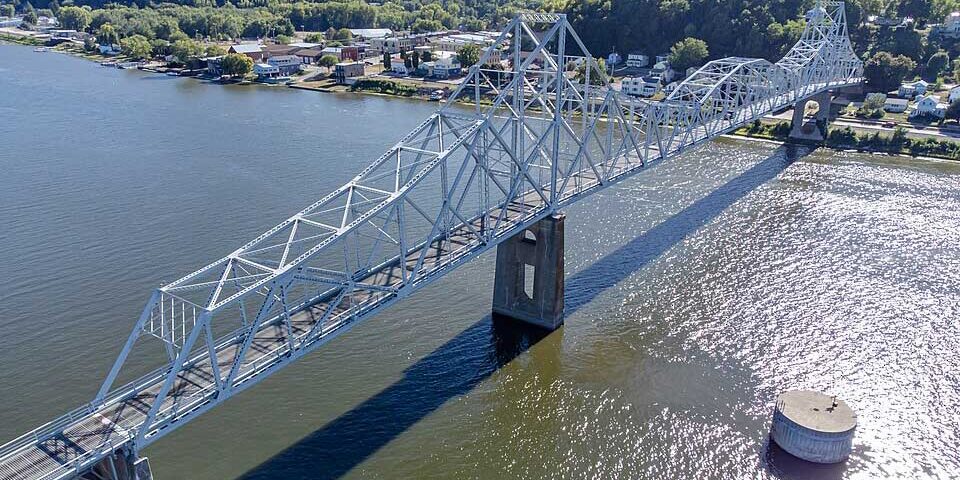
The original Black Hawk Bridge was a riveted cantilever through-truss that had been quietly doing its job since 1931, connecting Iowa Highway 9 to Wisconsin Highway 82 over the Upper Mississippi River and handling 2,100 vehicles a day.
Then, federal inspections rated the structure as deficient. Its deck spanned a mere 21 feet with zero shoulders, which, as anyone who has white-knuckled a crossing when a semi appears from the other direction can confirm, was genuinely nerve-wracking.

At 650 feet, the river’s navigation channel was tight enough that barges periodically tapped the piers. And so, after feasibility studies stretching back to 2004, the Iowa Department of Transportation (DOT) and Wisconsin DOT committed to a $140 million replacement.
What followed is a story AEC professionals should pay close attention to, not just because of the engineering achievement, but because of what the project quietly became: Iowa DOT’s first full-scale digital bridge delivery.
A Beloved Icon Gets a Digital Rebirth
The demolition on December 19, 2025, was dramatic. Controlled explosives brought down the historic superstructure, the steel splashing into the Mississippi in a live-streamed moment that the town of Lansing will mark for generations.
By that point, a new bridge was already rising right next door. Kraemer North America, headquartered in Plain, Wisconsin, had broken ground in November 2023 and construction of the 1,724-foot replacement, nearly twice as wide as its predecessor at 40 feet total, was well underway.
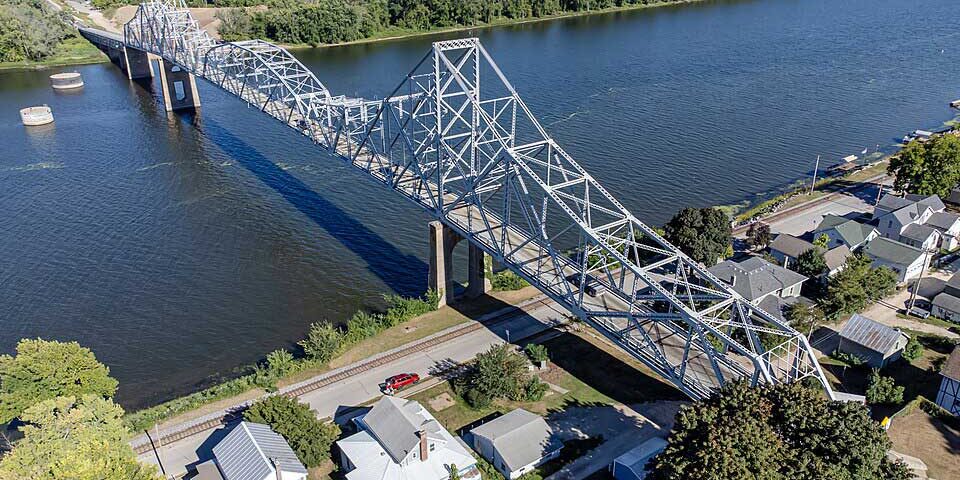
Visually, the new bridge was designed to honor the old one. During public outreach, the Iowa DOT made clear that the community’s attachment to the original structure would not be ignored. The superstructure for the new crossing was deliberately styled to echo the silhouette that locals had grown up with, preserving the character of that cantilever profile against the Mississippi River valley skyline.
The navigation channel, as part of the project, got a meaningful upgrade from about 650 to 750 feet, giving barge traffic considerably more room to breathe.
This is a project rooted in respect for its place both in local history and the landscape. But what makes it a landmark for the AEC industry has less to do with the steel and more to do with the data beneath it.
The Tech Stack
Engineering firm Foth Infrastructure & Environment and Parsons Corporation for the Iowa DOT used a suite of Bentley Systems® software, such as OpenBridge Modeler®, OpenRoads Designer®, and ProStructures® for 3D modeling. ProjectWise® managed the digital twin, and iTwin technology was used to publish the 3D BIM model.
A three-dimensional model served as the shared digital foundation for every discipline on the project.
This comprehensive 3D model served as the shared digital foundation for every discipline on the project with structural engineers, fabricators, contractors, inspectors and agency staff all working from the same coordinated information environment.
This was not a model that lived on someone’s workstation and got emailed around. According to Foth’s project documentation, the model was hosted on a cloud-based platform, meaning designers in one state and fabricators in another could access current, coordinated data through a web browser without needing specialized software. It’s the kind of workflow that sounds obvious in 2025 and yet, in practice, still separates genuinely mature digital delivery programs from projects that simply rely on accessing someone’s 3D file, stored somewhere.
The model captured every nut and bolt, every connection, all the structural steel, reinforcements and foundations at a high level of detail, making it possible to visualize construction sequencing for a project with genuinely complex geometry: a long-span truss being built in stages over a live navigable river, with a car ferry running nearby and barge traffic requiring careful coordination throughout.
When your construction sequence involves floating a central steel truss on a barge, positioning it mid-river and lifting it into place with hydraulic jacks, having a model that lets every stakeholder see exactly what is supposed to happen, and when, is not a luxury. It’s how you avoid expensive and unwanted surprises.
Quantifying What Digital Delivery Actually Does
How about some numbers that are worth lingering over?
Foth’s documentation reports that the model-based delivery contributed to an estimated 1.5-month schedule reduction and approximately $3.2 million in cost savings, driven by early conflict resolution and improved construction analysis. That kind of impact is difficult to ignore.
Think about what that means at the project level. A 6-week schedule reduction on a $140 million river bridge is not just a line-item improvement. It is weeks of reduced ferry operation costs, weeks of compressed risk exposure on a live construction site over a navigable waterway, and weeks of earlier economic connectivity for two small communities whose primary river crossing is currently a ferry running 16 hours a day.
For a rural community, that matters in ways that are hard to quantify on a cost-benefit spreadsheet.
The up-front investment pays dividends long after the last bolt is torqued.
Clayton Burke, Iowa DOT’s project manager for the crossing, has been quoted reflecting on the power of the model in the overall construction process, noting that the degree to which the model shaped and guided the project went beyond what the team initially anticipated. That kind of honest reflection is worth noting. DOTs aren’t often the first to admit when a technology exceeds their expectations, which makes the candor here more meaningful.
The Twin That Keeps Working After the Ribbon Cutting
Here’s the part of the story that most project announcements bury in the final paragraph, if they mention it at all: The model doesn’t stop being useful when construction ends.
Iowa DOT has indicated that the digital twin will continue to monitor the bridge throughout its operational life, facilitating inspections, access planning and asset management. In practical terms, this means that when an inspector needs to document a finding on a specific truss connection in 2035, he doesn’t have to go back to a set of drawings from 2024.
It may no longer be enough to rely merely on a 3D model …
The geometry, component data and inspection history can live in the same environment, updating over time, building a record that reduces the knowledge gap that typically plagues long-term infrastructure management.
This is the actual promise of a digital twin for infrastructure. It’s not a flashy visualization of a finished bridge. It’s a living model that carries the building’s story forward, reduces the cost of ongoing stewardship and keeps the people responsible for the structure informed in ways that would otherwise require significant manual effort.
For bridge owners and state DOTs watching what Iowa is doing here, the message is clear: The model you build during design and construction is also the model with which you maintain the asset. The up-front investment in data quality, model coordination and cloud accessibility pays dividends long after the last bolt is torqued.
What the AEC Industry Should Take from Lansing
There is a tendency to treat digital delivery as something that applies primarily to megaprojects: the high-speed rail corridors, the offshore platforms, the 20-year urban redevelopment programs. The 1,400 souls in Lansing and De Soto would argue otherwise.
This was not a simple project. Building a truss bridge over a major navigable river, with pile foundations drilled 80 to 120 feet into the riverbed to reach bedrock, while an aging and increasingly unstable structure sits right next to the construction zone? Coordinating with the Army Corps of Engineers and U.S. Fish and Wildlife Service, while spring flooding takes a month of your schedule away from you? And a regional community that depends on the only crossing within a half-hour drive? This is a project defined by real complexity at every turn.
The digital delivery framework didn’t eliminate that complexity, but it gave every team member better information, faster, with fewer gaps and fewer expensive late-stage surprises. That’s a story that favorably scales to almost any project of consequence, which is almost every project.
For AEC firms looking at where digital delivery is headed, the new bridge also illustrates how the use of technology is evolving.
This is what it looks like when digital delivery works.
In many cases, it may no longer be enough to rely merely on a 3D model. The value emerges when that model is connected to real-time coordination workflows, cloud-accessible to every project stakeholder, integrated with issue tracking and construction analysis, and designed from day one to support the asset’s entire operational life, not just its construction phase.
A Bridge Built for the Next Century
The new Mississippi River Bridge at Lansing (which locals are expected to refer to either as the new Black Hawk Bridge or the Lansing Bridge) is scheduled to open in 2027, with single-lane access targeted for the spring of that year.
When it opens, it will carry two 12-foot driving lanes and 8-foot shoulders across a span designed to look like the crossing locals grew up loving, while performing in ways the original could never have managed. And no more white-knuckle crossings.
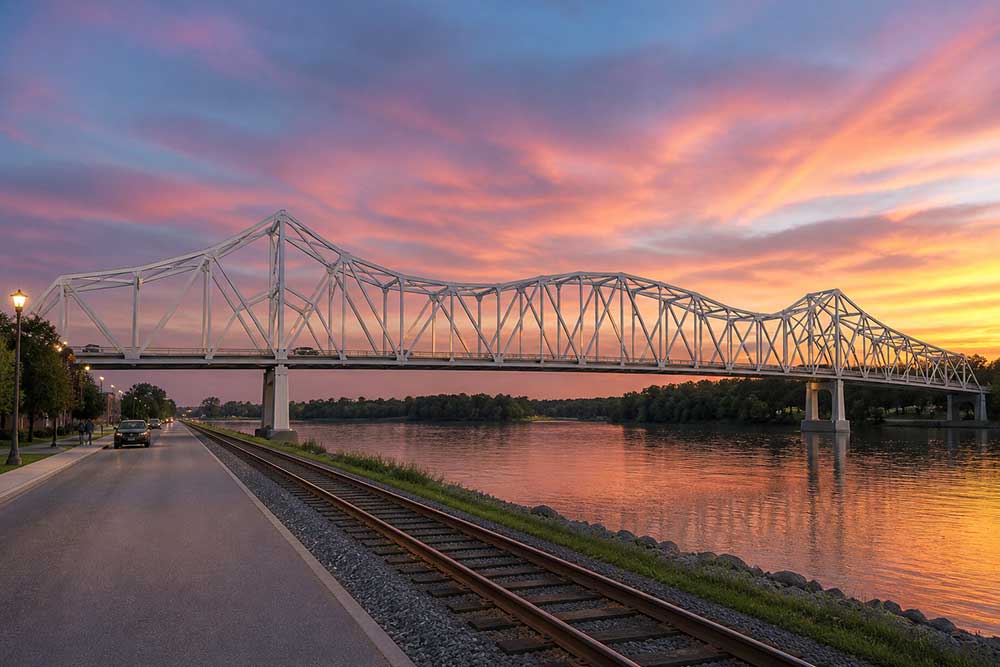
The residents of Lansing are already planning to salvage material from the old bridge for keepsakes and a community tribute. It is hard not to admire that fondness.
The Black Hawk Bridge earned its place in the landscape of northeastern Iowa over 94 years of service. But the project that replaces it has earned something different: a place in the story of how the modern AEC industry builds smarter.
Iowa DOT’s first digital bridge delivery didn’t just produce a better-coordinated project. It demonstrated a result that other owners and engineering teams can look at and say: This is what it looks like when digital delivery works.
And that is a legacy worth building on, one winning model at a time.
If you’re looking for ways to save time, improve accuracy and smooth workflows, Axiom specializes in tools for MicroStation®, Revit®, AutoCAD® and BricsCAD®. Chat with us online or call 727-442-7774 to speak to a Service Consultant about your particular project needs.
